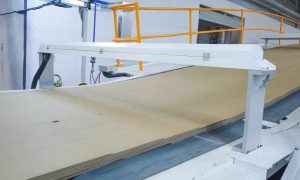
When comparing a new corrugator line, speed, working width, and purchase price usually receive the most attention. But over the next 10 or 15 years, energy consumption can have just as much impact on the total cost of ownership. Steam, electricity, process heat, and material waste all add to the operating cost of every square meter of board produced. The real question, then, is not whether a corrugator line is marketed as “energy-efficient,” but which technologies actually reduce energy losses in day-to-day production.
Why Energy Efficiency Matters in Corrugator Line Operations
Energy is one of the largest controllable cost centers in corrugated board manufacturing. Industry research on corrugator operations notes that energy consumption in industrial processes for corrugated board manufacture can account for roughly 30-40% of total production costs, which is why engineers and plant managers are under constant pressure to find efficiency gains. On top of cost pressure, environmental regulation is tightening. In addition to the pressure on costs, environmental regulations are tightening. Industries that rely on steam, such as pulp and paper are legally required to disclose and limit carbon emissions resulting from steam generation. Corrugated converters aren’t exempt. The effect of the two is clear: corrugator lines that waste heat or run motors that are not efficient is draining cash and causing unnecessary carbon emissions in the process.
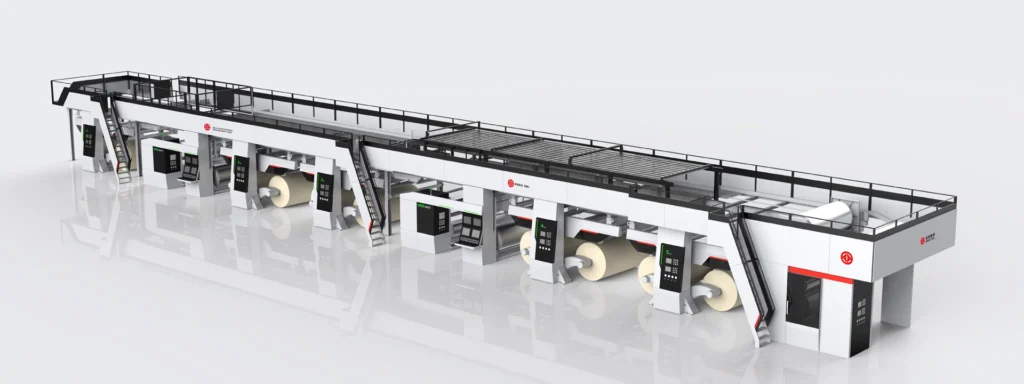
Key Energy-Consuming Stages in a Corrugator Line
Before comparing technologies, it helps to know where the energy actually goes. A typical corrugator line consumes power and thermal energy across four main stages:
- Preheating and steam supply — heating paper rolls before the corrugating and gluing stages
- Corrugating and pressure control — forming the flute in the single facer
- Drying sections — removing moisture from the single-faced and double-faced board
- Main drive and transport systems — running the line at speed and coordinating tension
Steam and thermal processes dominate this list. Research on steam systems in energy-intensive industries shows that pulp and paper operations devote around 81% of their fossil fuel consumption to steam production, which is why steam handling is usually the first place to look for savings on a corrugator line.
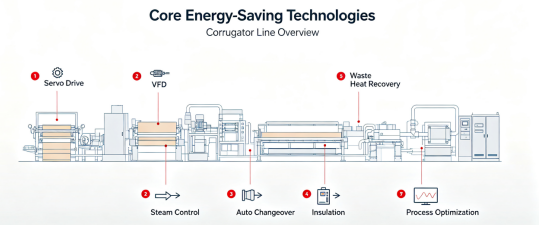
Core Energy-Saving Technologies to Look For
Servo-Driven Systems
Servo motors take the place of older mechanical or air-powered drive parts. They run on digital control, so the motion can be set with tight accuracy. Since they use power only when the motion is actually happening, they reduce the wasted energy seen in other drive types. This helps with problems during order shifts and when speeds are being changed.
Variable Frequency Drives (VFDs)
VFDs allow motors to run at the speed that the process requires instead of full-speed operation with mechanical throttle. On fans, pumps, and conveyors throughout a corrugator line, this alone can meaningfully reduce electrical draw during partial-load operation.
Waste Heat Recovery Systems
Drying sections produce huge quantities of exhaust heat, which typically vents into the atmosphere. Systems for heat recovery capture the energy and use it to warm fluids or water for processing. Since thermal energy is the largest portion of the total energy consumption, recovery systems that target the heating and drying circuits are likely to have the most rapid paybacks for an industrial corrugator line.
Intelligent Steam Control and Steam Traps
Poorly maintained steam traps and unregulated pressure are a common source of silent energy loss. A documented plant-level intervention that lowered boiler steam pressure and standardized temperature settings by paper weight reported a 9% reduction in gas energy consumption alongside a drop in material waste. Modern corrugator lines increasingly pair steam traps with automated pressure and condensate monitoring to catch these losses before they compound.
Automated Order Change-Over
Manual changeovers often leave sections idling at temperature while operators adjust settings, wasting both steam and electricity. Automated splice and order-change systems shorten this downtime, keeping the line from heating empty capacity.
Insulation and Thermal Design
Simple as it sounds, insulation on steam lines, dryer hoods, and preheat cylinders reduces radiant heat loss throughout a shift. The cost is small, but the payoff keeps stacking up with the other steps below.
Data-Driven Process Optimization
Newer control systems show temperatures, speed, and pressure as the job runs. Operators can change settings on the fly instead of using the same fixed setup every time. Process control systems that integrate into modern corrugators incorporate this information directly into the user interface. Researchers have identified AI-assisted optimization as an increasingly effective method of cutting down on energy and material wasted in the manufacturing of packaging.
How to Compare the Energy Efficiency of Two Corrugator Lines
When comparing providers, avoid not relying solely on one headline statistic like “20% lower energy consumption.”
Instead, compare the operating conditions behind the claim.
| What to Compare | What to Ask |
| Steam consumption | At what speed and board specification was it measured? |
| Electricity consumption | Does the figure represent production or idle operation? |
| Heat management | How are temperature and steam adjusted? |
| Condensate recovery | Is the system designed to recover and reuse condensate? |
| Process control | Can parameters adapt to changing paper grades and speeds? |
| Waste reduction | What systems help control warp, glue, and process stability? |
| Production monitoring | Can performance and energy-related data be tracked over time? |
This approach is particularly important because a corrugator line’s maximum design speed does not necessarily represent its normal working performance. Actual output depends on paper quality, flute profile, heating conditions, adhesive application, and overall machine stability.
Don’t Judge Energy Efficiency by One Number
If a supplier claims that a corrugator line saves energy, the next question should be:
Compared with what?
The answer should consider the same board grade, working width, production speed, flute profile, and operating conditions. A line tested under one set of conditions cannot automatically be compared with another running a different product mix.
Energy efficiency should also include more than electricity. Steam, process heat, condensate recovery, waste, downtime, and overall production stability all affect the amount of energy required to produce one unit of saleable corrugated board.
Which Technologies Matter Most for Your Factory?
The best priorities are based on the sources of your current costs being sourced.
- If fuel or steam costs are excessive, first focus on the management of steam and insulation, as well as heating transfer and recovery of condensate.
- If the consumption of electricity is your primary concern, consider motor control, variable speed drives and the efficiency of auxiliary equipment.
- If you are facing a significant waste issue, you should prioritize an adaptive process control system, precise adhesive application and warp management as well as production analysis.
- If your factory handles frequent order changes, automated recipes and faster parameter adjustment may deliver greater savings by reducing setup time and off-spec production.
Choosing the Right Corrugator Line Partner
Technology alone doesn’t guarantee results — implementation and support matter just as much. A supplier’s track record with servo integration, steam system design, and after-sales support determines whether these energy-saving features perform as promised over years of operation, not just during commissioning. Manufacturers like Hsieh Hsu Machinery design corrugator lines with these efficiency considerations built in from the drive system to the drying section, which is worth exploring for teams evaluating a line upgrade.