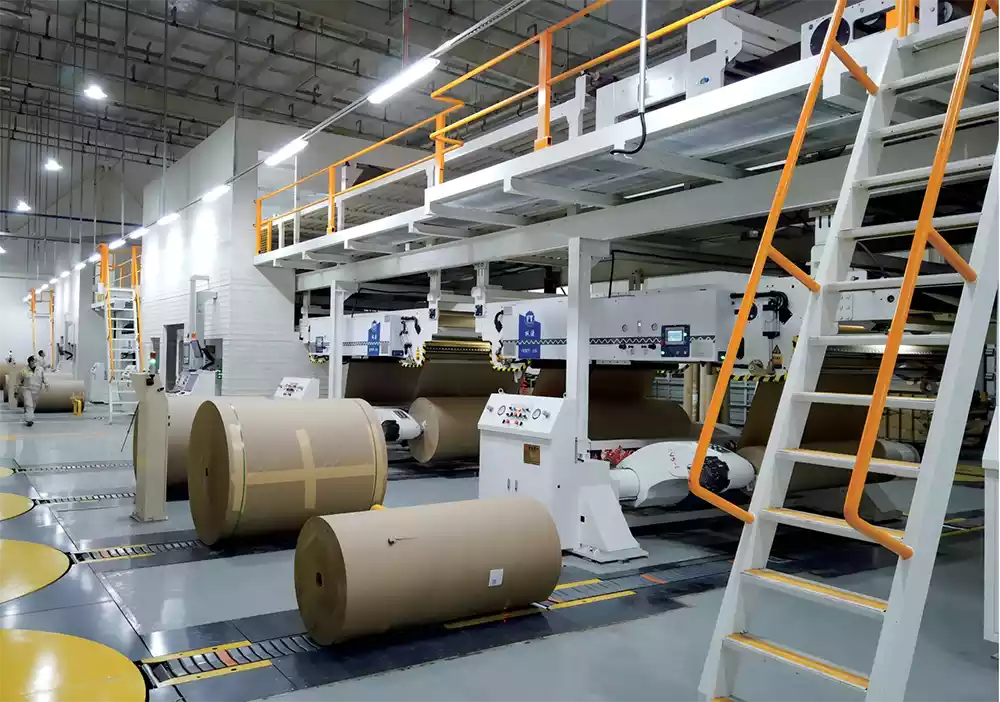
A nameplate on the corrugator says 300 m/min. That monthly average is almost always well below that and it’s rarely one catastrophic failure. The speed bleeds out in small, quiet ways: heat limits, paper changes, order changes, and the little stops that no one bothers to log. Rated speed is a ceiling, not a forecast; plants that treat it as a ceiling usually outproduce plants that chase it. Below we separate rated speed from actual output, and show what the better plants really run. Then we go through the six limits, and a simple way to find your own.
Rated Speed, Running Speed and Actual Output Are Three Different Numbers
Most disputes between buyers and suppliers start with mixing these up.
- Design (rated) speed: the maximum the machine is built to reach, usually on a favorable board grade.
- Average running speed: the mean speed while the line is producing. It drops with every slow-down for splices, order changes and difficult board.
- Actual output: Good board per shift after downtime, trim and rejects.
Two lines with the same 300 m/min rating can differ by 30% in daily production. Always ask what speed of corrugator line is being quoted and for what flute/board combination when comparing.
What Do Well-Run Lines Actually Achieve?
Published record shifts show what is possible when everything goes right. At Mpact Kuils in South Africa, a BHS corrugator with a 300 m/min maximum speed produced 145,207 running meters in eight hours at an average of 304 m/min. In Mexico, Cuautipack recorded a 307 m/min shift average and 157,351 meters on a Fosber line running B flute and BC double wall. In Italy, Toppazzini logged 345 m/min and 166,245 meters with zero downtime.
The arithmetic is revealing. A 480 minute shift at 304 m/min is about 145,900 meters so that record shift was full pace almost every minute. Records demand high speed and near perfection.
These are the manufacturer’s best case scenarios, not the average day-to-day ones. Wide variations in ratings by class of line also occur. On one supplier listing, entry-level lines are in the 60-220 m/min range, while BHS quotes up to 400 m/min for its wide format line. What is a “good” speed? Well that depends on what you bought and what you run.
Six Factors That Limit Throughput
Walk the line from wet end to dry end and the limits become easier to spot.
1. Board grade and the weakest layer. Kiwiplan explains that the liner, medium or flute layer that constrains a board combination sets its permitted speed. Double wall and heavy grammage therefore run slower than light single wall, whatever the nameplate says.
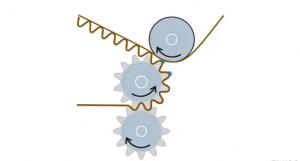
2. Heat and bond time. Starch glue must gel before the board leaves the hot plates, so faster travel means less time to bond. A Denver plant described by Kadant could not run double wall above 550 fpm, about 168 m/min, because glue lines had too little time to set. Sometimes the limit is thermal, not mechanical.
3. Paper supply and splicing. Every roll change is a chance to slow down, waste paper or stop. Poor roll planning and unsynchronized splices quietly lower the average.
4. Order changes and trim. Each change needs new slitter and cut-off settings, and short-run mixes multiply the losses. Width matters too: BHS notes that a wider working width reduces trim loss.
5. Match, dry end. Wet end must be able to keep up with the slitter scorer, cut-off and stacker. If they can’t, the bridge fills up and the entire line slows.
6. Dependence on operator and downtime. Small hiccups nobody records, and large variations between teams, eat away at output more than most managers expect. Toppazzini’s no-downtime change reflects the value of uptime.
How to Measure Your Own Gap with OEE
The gap becomes one number: Availability x Performance x Quality, which is called Overall Equipment Effectiveness (OEE). A commonly quoted world-class benchmark is a score of 85%, based on availability of about 90%, performance of 95%, and quality of 99%, which can be traced back to the Total Productive Maintenance framework of Seiichi Nakajima. It is an ‘across industry’ figure so set your own target for corrugators.
Here’s an example of an 8-hour shift on a 300 m/min line (example numbers, not benchmarks):
| Factor | Calculation | Result |
| Availability | 420 running minutes ÷ 480 | 87.5% |
| Performance | 255 m/min average ÷ 300 m/min rated | 85% |
| Quality | Good board ÷ total board | 96% |
| OEE | 0.875 × 0.85 × 0.96 | 71.4% |
That shift delivers about 102,800 good meters against 144,000 theoretical. The line was never “slow”. It lost time and speed in small pieces.
To find your own losses:
1.Attack the largest loss first.
2. Log every stop by cause for one week.
3. Compare average running speed with the board-specific speed, not the nameplate.
Practical Ways to Raise Output Without Simply Raising Speed
Fix the true constraint first. Kadant reports that adding steam assist at the double facer raised double wall speeds about 20% in virtually all cases. Upgrading the wrong machine would have achieved nothing.
Reduce change and eliminate waste.Automation vendor Amtech says synchronized wet-end and dry-end controls can improve productivity by 8-12% and reduce waste by 0.25-0.50%. These are vendor claims, so check against your own data.
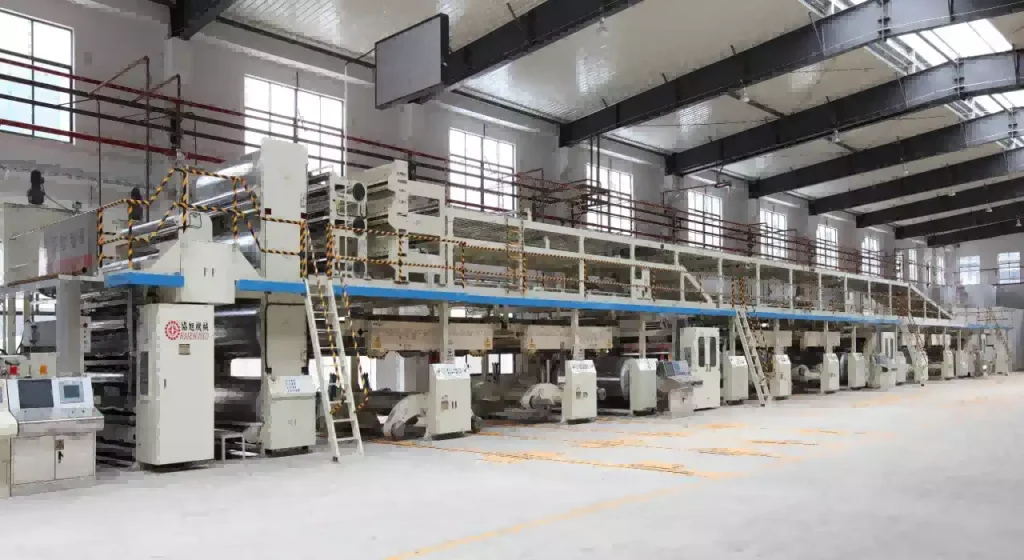
Reduce dependence on operator experience. Hsieh Hsu Machinery describes full-process intelligent control with automatic speed-up and slow-down cruise production and real-time visual KPI reports. Matched equipment helps as well,such as the MSF-40P single facer at the wet end and the NC-C158H helical cut-off at the dry end. If you are planning an upgrade, start with how to choose the right corrugator line for your factory.
What to Ask a Supplier Before You Buy
- Can you share real shift-average output from a similar plant?
- Which board grade and flute combination does the rated speed apply to?
- Are the wet end and dry end matched at that speed?
- How is heat and bond capacity handled at high speed on double wall?
FAQ
What is a good corrugator line speed?
It depends on line class and board grade. Entry-level lines are rated near 100 m/min, while top-end lines are rated at 300 m/min and above. Judge it by shift-average speed on your own board mix.
Why does my corrugator run slower than its rated speed?
Common causes are heavier board grades, limited heat at the double facer, splices, order changes and unlogged minor stops.
Does higher line speed always mean higher output?
No. A faster line with frequent stops or high waste can deliver less good board than a slower, steadier one.
Final Thoughts
Line speed is where throughput starts, not where it ends. Measure your OEE, find the largest loss, and fix that before paying for more speed. To review your line’s layout and targets with an engineer, contact Hsieh Hsu Machinery.