When a corrugator line runs unevenly — web wrinkles, misaligned splices, unexplained speed drops — most maintenance teams start troubleshooting at the single facer or double backer. But a surprising number of these problems trace back further upstream, to a component that rarely gets blamed: the mill roll stand. As the very first station in the wet end, its job of holding, unwinding, and feeding the base paper roll sets the tension and alignment conditions that every downstream station has to work with. This article breaks down exactly how — and why.
What Is a Mill Roll Stand?
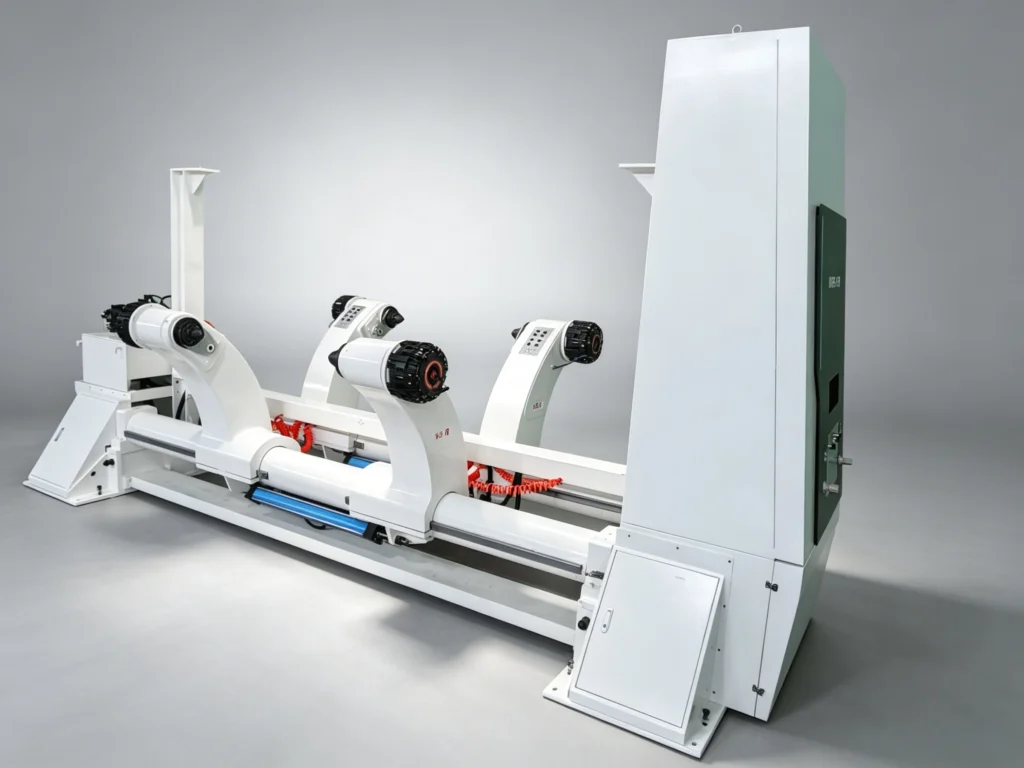
A mill roll stand is the wet-end unit that clamps and unwinds the large base paper roll, feeding it into the single facer at the correct tension. It’s positioned at the very front of the corrugator line, ahead of the preheater and single facer — which means it’s also the first point where instability can enter the system.
Think of it as the foundation of the entire wet end. If the paper feeds in unevenly, no amount of tuning further down the line can fully compensate. That’s why experienced plant engineers increasingly treat the roll stand not as a passive holding fixture, but as an active control point for line performance.
Why Line Stability Starts at the Roll Stand
Three mechanisms explain why roll-stand performance shows up as line-wide stability — or instability.
Unwind Tension Consistency
As a paper roll unwinds, its diameter shrinks continuously — from a full roll down to the core. If the braking system doesn’t adjust to that changing diameter, tension drifts. Loose tension causes wrinkling and poor ply bonding at the single facer; excessive tension causes web breaks and flute crushing. Either way, the defect often gets diagnosed at the single facer, when the real cause is a tension curve that was never properly held at the source.
Roll Alignment and Clamping Precision
A roll that isn’t clamped square to the line axis will unwind with a slight lateral drift. Over a few hundred meters of paper, that drift compounds into web wander — forcing downstream alignment systems to constantly correct, which shows up as edge trim variance and, in worse cases, misregistration at the printing or slotting stage.
Roll-Change Downtime
Every roll change is a stop in production. On a single-roll stand, that stop is unavoidable — the line waits while the spent core is removed and a new roll is loaded and threaded. Multiply that by the number of roll changes in a shift, and it becomes one of the largest hidden contributors to lost OEE (overall equipment effectiveness) on many corrugator lines, even though it rarely appears as a single, obvious fault.
Key Design Factors That Determine Roll Stand Performance
Once you know where instability originates, the next question is which design choices actually control it.
Shaftless vs. Shafted Designs
Shafted stands require a center shaft to be threaded through the roll core before mounting — an extra manual step that adds time and introduces alignment risk with every change. Shaftless designs clamp the roll directly from the ends, cutting that step out entirely and adapting more easily to varying core sizes.
Hydraulic vs. Manual Clamping and Lifting
Manual clamping depends on operator technique, which varies shift to shift and operator to operator. Hydraulic clamping and lifting apply consistent, repeatable force every time — reducing both the physical effort required and the variability that manual operation introduces into roll alignment.
Braking and Tension Control Systems
This is where the diameter-tension problem gets solved. A well-tuned brake — whether a manually adjustable air brake or a more advanced multi-point braking system — maintains consistent unwind resistance as the roll diameter decreases. The more precise the braking system, the tighter the tension band the line can hold, which translates directly into fewer wrinkle and breakage defects downstream.
Single-Roll vs. Dual-Roll (Swing-Type) Configurations
A single-roll stand can only ever process one roll before requiring a full stop. A dual-roll, swing-type stand holds a second roll staged and ready — so when the running roll depletes, the stand swings the new roll into position with far less line interruption. This design shifts roll-change downtime from a full production stop to a much shorter transition.
A Practical Example — How These Factors Come Together
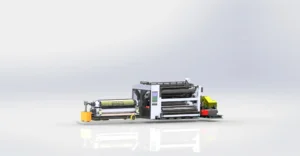
These design principles aren’t just theoretical. Hsieh Hsu’s MRS-V4, a swing-type hydraulic shaftless mill roll stand, illustrates how they translate into measurable specifications:
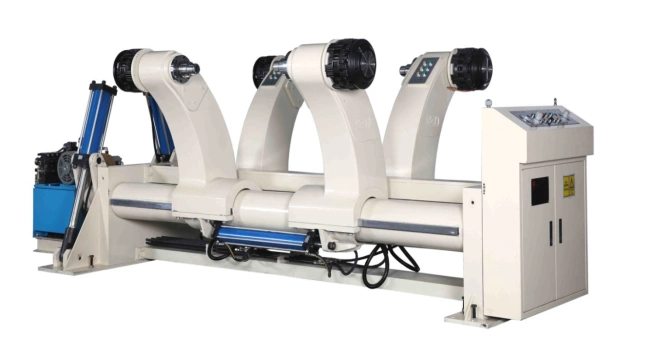
- Dual-roll staging: each stand carries two pairs of arms, holding two mill rolls at once, so the next roll is already positioned when the running roll runs out — directly addressing the roll-change downtime problem described above.
- Full hydraulic control: open-close clamping, left-right positioning, and lift-lowering are all driven by a self-contained 7.5 HP hydraulic power unit, removing manual variability from the clamping process.
- Matched cylinder set: two Ø100 × 450 mm clamp cylinders and four Ø63 × 700 mm lift cylinders are sized and paired specifically for balanced clamp and lift force — a detail that matters because uneven clamping force is itself a source of roll misalignment.
- Tension control: a manually adjustable air brake holds unwind tension up to a 1,500 mm max. paper diameter, with an optional imported multi-point brake for plants that need tighter tension precision.
The point isn’t that any one feature solves everything — it’s that each design choice maps to a specific mechanism of instability identified above.
What to Consider When Specifying a Mill Roll Stand for Your Line
For teams evaluating a new stand or a line upgrade, a few practical questions narrow the decision quickly:
Tension precision requirements — high-speed or high-spec lines may justify the added cost of a multi-point brake over a standard air brake.
Maximum roll diameter — does the stand’s rated capacity match your current and anticipated paper roll sizes?
Roll-change frequency — if changes are frequent, a dual-roll swing-type stand may pay for itself in reduced downtime alone.
Plant layout and track space — track-and-dolly mounted stands need adequate floor clearance for roll loading and staging.
The Bottom Line
Corrugator line instability is often diagnosed at the symptom — a wrinkle, a break, a misregistration — rather than at the source. Understanding how tension control, clamping precision, and roll-change design at the mill roll stand shape everything downstream gives plant engineers and procurement teams a clearer basis for both troubleshooting and equipment selection.