The use of lightweight containerboard assists companies in decreasing material utilization and producing lighter packaging. But it does not necessarily mean that companies can decrease material utilization during the corrugated paperboard manufacturing line. The density, thickness, moisture level, and tensile strength of the paper will influence the behavior of the paper sheet under the heating, tension, and adhesives in the process.
The main problem for corrugated paperboard producers is how to keep stability of corrugation, adhesion, and quality of paperboard in more narrowed process control interval. This knowledge will assist the operators in making decisions about the suitability of their equipment and operational parameters for the light paper.
How Lightweight Paper Changes the Corrugating Process
Heat Transfer and Temperature Control
Lightweight paper grades can respond to heat differently from conventional heavier papers. In particular, some lightweight, high-density papers have less insulating capacity and may heat up more rapidly during corrugating.
A technical presentation published in TAPPI Corrugating International discussed how rapid heat transfer in lightweight board can affect the adhesive gelling profile. It highlighted the need for tighter temperature control because the paper and adhesive may reach critical process temperatures more quickly than expected.
This means operators should not rely solely on temperature settings used for heavier grades. Preheater wrap, steam application, machine speed, and the temperature of the paper entering each bonding section may all need to be reviewed.
The goal is not simply to increase or decrease heat, but to provide enough energy for proper flute formation and starch gelatinization without removing excessive moisture from the paper. The appropriate settings depend on the paper grade, adhesive formulation, and equipment configuration.
Web Tension and Paper Breaks
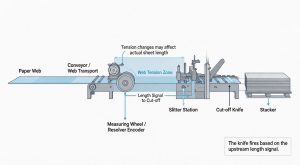
Lightweight paper generally has low strength and is unable to withstand the forces of unwinding, paper guiding and corrugation forming. Excessive paper tension can cause paper stretching, paper breakage or unstable operation.
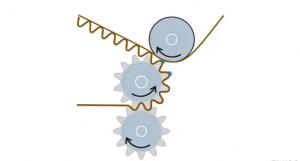
When corrugated base paper undergoes corrugation forming through corrugating rollers, it also experiences additional mechanical stress. The Indian Corrugated Board Manufacturers Federation (FCBM) explains that this process involves both paper running tension stress and corrugation forming deformation stress.
Operators need to set the tension separately according to the characteristics of the paper type and cannot simply use the production parameters of thick paper.
Important areas to check include:
- Unwind and brake tension, particularly when changing paper rolls.
- Web alignment and tracking through the single facer.
- Paper condition, including edge damage and uneven winding.
- Tension differences between the liner and medium.
Stable web handling helps reduce paper breaks, wrinkles, and irregular flute formation.
Adhesive Application and Bonding
A reduction in paper weight may also have an effect on the paper’s ability to bond using starch adhesive. Paper absorptivity and porosity play an important role in how water transfers from the adhesive into the paper, as well as the ability of the adhesive to penetrate the bonding surfaces.
As FCBM explains, there may be issues related to the bonding of papers due to either too high or too low absorptivity. High absorptivity will result in the extraction of water before reaching the gel point, while too little absorptivity means that the adhesive will not penetrate.
This is especially important when switching to a new type of lightweight paper.
Operators should monitor:
- Adhesive viscosity and solids content.
- Glue application consistency across the web.
- Glue-line condition and bonding strength.
- Paper absorption characteristics.
- Bonding performance at different machine speeds.
Rather than increasing adhesive application whenever bonding becomes unstable, manufacturers should first identify whether the issue comes from paper absorption, temperature, moisture, or adhesive condition. Excessive adhesive can introduce additional water into the board and contribute to warp.
Moisture Balance and Board Flatness
The moisture level is among the most significant factors that have an effect on the flatness of corrugated board. When manufacturing corrugated board, the paper is exposed to heat, steam, and water-based starch glue. All of these processes result in changes to the moisture levels of each paper layer.
Different moisture absorption rates for the liners and medium can lead to various deformations.
The FEFCO, Groupement Ondulé, and European Containerboard Organization have noted that both the general level of moisture and the moisture difference within a paper roll are critical to the efficiency of corrugators. These organizations recognize that there is a connection between moisture uniformity, board flatness, bonding, and runnability.
For lighter weight boards, the manufacturers should be careful about the moisture difference within the width of the reel and not just the general moisture content of the paper roll. There could be moisture inconsistency in the entire reel even when the average value is consistent.
Incoming paper moisture, steam, preheat, and flatness of finished board are some ways of determining moisture inconsistency.
What Corrugated Board Manufacturers Should Monitor
When introducing lightweight containerboard, it is useful to evaluate the whole corrugating process rather than adjusting one machine parameter at a time.
| Area | Key factors to monitor | Possible production issues |
| Paper properties | Grammage, thickness, moisture, tensile strength, absorption | Web breaks, unstable forming |
| Web handling | Unwind tension, alignment, tracking | Wrinkles, stretching, paper breaks |
| Heating | Preheater temperature, steam application, machine speed | Over-drying, poor flute formation |
| Adhesive system | Viscosity, solids content, application consistency | Weak bonding, excess moisture |
| Finished board | Flute profile, bonding, flatness, caliper | Warp, crushed flutes, inconsistent quality |
It is also important to compare production results across different paper grades. Recording the operating conditions and quality results for each grade gives operators a practical reference when switching materials.
Can Existing Corrugators Handle Lightweight Paper?

Not every lightweight paper application requires a new corrugator. In many cases, existing equipment can process lighter grades if its mechanical condition and control systems are suitable.
However, manufacturers should evaluate several areas before making the change:
- Tension control: Can the unwind and web-guiding systems maintain stable tension at lower paper strengths?
- Heating control: Can preheaters and steam systems provide consistent heating without excessive moisture loss?
- Glue system: Can the adhesive applicator maintain an even and controlled glue line at the required production speed?
- Corrugating rolls: Are the rolls, pressure settings, and mechanical alignment suitable for the intended flute profile and paper grade?
The state of the machinery is just as important as the initial design of the equipment. Deteriorated rolls, uneven pressure, incorrect alignment, or tension control problems might make it harder to produce thin paper.
It may be useful to conduct some tests using the required paper grade, note the parameters, and check flute structure, bonding, and board flatness. It will give a more accurate answer on whether process changes or machinery improvements are needed.
Lightweight Paper Requires More Consistent Process Control
Lightweight containerboard may assist in lowering the weight of packaging, although at the same time increasing the importance of process uniformity. Factors such as heat transfer, web tension, glue application, and moisture all play an important part.
In the case of manufacturers of corrugated boards, efficient production of lightweight papers requires knowledge of the behavior of each paper grade, together with stable control during the corrugation process. By conducting production tests to inspect the equipment condition and verify the settings, manufacturers can improve their existing corrugated paperboard production lines while maintaining reliable paperboard quality.
References
- TAPPI. Bonding Lightweight Boards. Corrugating International, 2007. Read the technical presentation
- Federation of Corrugated Box Manufacturers of India (FCBM). Exploring the Technical Specifications of Fluting Media. Read the article
- FEFCO, Groupement Ondulé & European Containerboard Organisation. Moisture Guidelines. Corrugator Efficiency Working Group. Read the guidelines