Last spring, a beverage plant sent back a pallet of corrugated boxes. The packing line kept jamming, and everyone blamed the die-cutter. It wasn’t. The slitter scorer had been running with a worn scoring wheel, so fold lines landed 1 mm off and the flaps wouldn’t close square.
That’s the thing about slitter scorers: they set sheet width and crease position before anything gets printed or die-cut, so small errors here carry through to every later step. Below, I’ll go through what the machine actually controls, how crease quality shows up in the finished box, the faults worth checking first, and what to ask a supplier before buying.
What a Slitter Scorer Does on the Corrugator
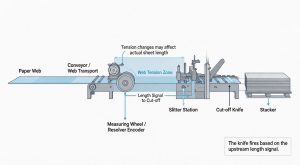
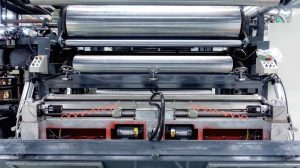
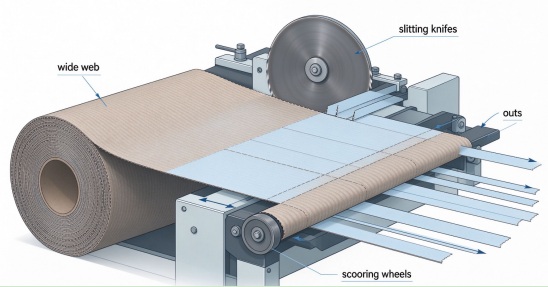
On a corrugator line, the slitter scorer sits after the double backer and before the cut-off. The board arrives as one wide web, and the machine does two jobs on it. Slitting knives cut the web lengthwise into narrower sheets, usually called “outs,” and trim the edges. Scoring wheels press crease lines in the same direction so the board folds cleanly later.
Several orders often run side by side across the web. That means knives and wheels must be repositioned accurately at every order change.
Which Corrugated Box Dimensions Does It Control?
Not all of them. Take the regular slotted container (RSC), the most common box style, as a typical case. The slitter scorer’s lines run along the machine direction, so it governs what happens across the width of the sheet. Layouts vary with box style and flute direction, so check your own.
| Dimension | Set by | Slitter scorer’s role |
| Sheet width (slit to slit) | Slitting knives | Direct |
| Distance between score lines | Scoring wheels | Direct, usually box depth plus scoring allowance |
| Flap fold position | Scoring wheels | Direct |
| Trim width | Edge knives | Direct, affects waste |
| Sheet length | Cut-off | None |
| Panel folds and slots | Printer-slotter or die-cutter | None |
One detail catches people out: the distance between two score lines is not the inside dimension of the finished box. ASTM D2658, the standard test method for box dimensions, says interior size can be estimated from score-to-score measurements only after a scoring allowance is taken into account. Packaging suppliers publish those allowances by flute type. So a small error in score spacing does not just move a fold line. It carries straight into the box your customer measures.
How Scoring Quality Changes the Finished Box
A sheet can measure perfectly flat and still fold into a bad box. Three things make that happen.
Profile and score depth. If it is too shallow, the board will resist being folded, bulged or spring-back. Too deep and the liner cracks, or the flutes get crushed. This was tested with the USDA Forest Products Lab through the Fibre Box Association. The study employed single-wall RSCs of 21 × 15 × 16 inch in 32 ECT and 44 ECT board. The study found that score profile can change box compression strength by more than 10 percent, and score cracking alone reduced strength by 10 percent or more. A poorly scored fold affects the appearance of the box and how it stacks.
Position score. Depth gets most of the attention, but how you set them is just as important. The patent on score-line devices states that the gap tolerance is very important in automatic packaging because it determines the accuracy of the folding of the box.
Slit edge quality. Dull or poorly maintained knives leave rough edges and let sheet width drift. Machine design helps here. The Hsieh Hsu bottom-type slitter scorer cuts from below, a layout the company says limits fish-tail defects on the printed surface.

Common Size Problems and What to Look For
Many stations can produce the same symptoms so make sure you know what is causing it before you change anything. This table can be used as a starting point to check the slitter scorer.
| Symptom | Possible cause | What to check |
| Box will not square | Score lines misaligned or board wandering | Score positions, board guidance |
| Cracking at the fold | Score too deep or wrong profile for the grade | Depth setting, profile choice |
| Bulging or stiff folds | Score too shallow | Depth setting |
| Width drifts within a run | Knife position drift or wear | Calibration, blade condition |
| Rough slit edges | Dull blades | Grinding interval, blade life |
Keeping Dimensions Consistent
Customer tolerances leave little room. One published example is Snap-on’s corrugated box standard, which references ASTM D2658. It provides ±1.6 mm for boxes 4 to 25 inches in size and ±3 mm for boxes 26 to 50 inches in size. With that margin, every extra millimetre that the machine can add is counted.
Here’s what a practical routine looks like:
- Keep the board level. A warped board or one that wanders will shift the score lines even if the machine is set properly.
- Calibrate regularly. Check knife and scoring-wheel positions regularly, not only when a problem shows up.
- Set score depth by grade. Match depth to board grade and flute, and record the settings for each order.
- Grind blades by meters run. Base the interval on production meters and paper type, not on feel.
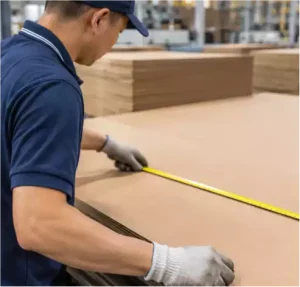
- Measure the first sheet after each order change. Check slit to slit and score to score before releasing the run.
What to Look for in a Slitter Scorer
Hsieh Hsu has built corrugator equipment since 1980. Its N.C. slitter scorer, RRLB-SH bottom type, shows how the points above turn into design features.
| Feature | Why it matters for box size |
| Linear bearing guidance, ±0.5 mm mechanical accuracy | Keeps knife and wheel positions stable |
| Servo-controlled scoring depth, Ø270 mm upper wheel | Repeatable depth for each board grade |
| Three lower profiles: male to male, male to female, male to flat | Matches the crease to the board |
| Independent blade grinding, programmable intervals | Keeps slit edges consistent |
| Automatic paper pressing, anti-bending device, motorized web suction | Keeps board flat in transit |
| 4, 5 or 6 OUT (5/6/7 blades, 8/10/12 score lines) | Fits different order mixes |
One caution: ±0.5 mm is the machine’s mechanical accuracy, not a guarantee of finished box tolerance. That also depends on board, flute, settings and the stations downstream, such as the helical cut-off that sets sheet length.
The Bottom Line
The slitter scorer determines sheet width and score spacing, the first big influence on corrugated box size. It gets scored and if the score is correct then a correctly sized sheet folds into a correctly sized box. A symptom check and a steady routine will allow most size problems to be traced. When choosing a machine, pay attention first of all to positioning accuracy, depth control and board handling. .For configuration details, contact the Hsieh Hsu team.