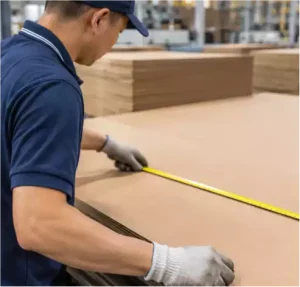
You set the order to a fixed length, pull a few sheets off the stacker, and one is a couple of millimeters long while the next is short. The knife is the first suspect, and sometimes it’s guilty. More often it isn’t. Corrugated board cutting accuracy depends on everything between the point where length is measured and the moment the knife fires, so the real cause can sit well upstream.
Let’s walk through the most common causes, what each one looks like on the floor, and a sensible order for checking them.
Where Cut Length Actually Gets Decided
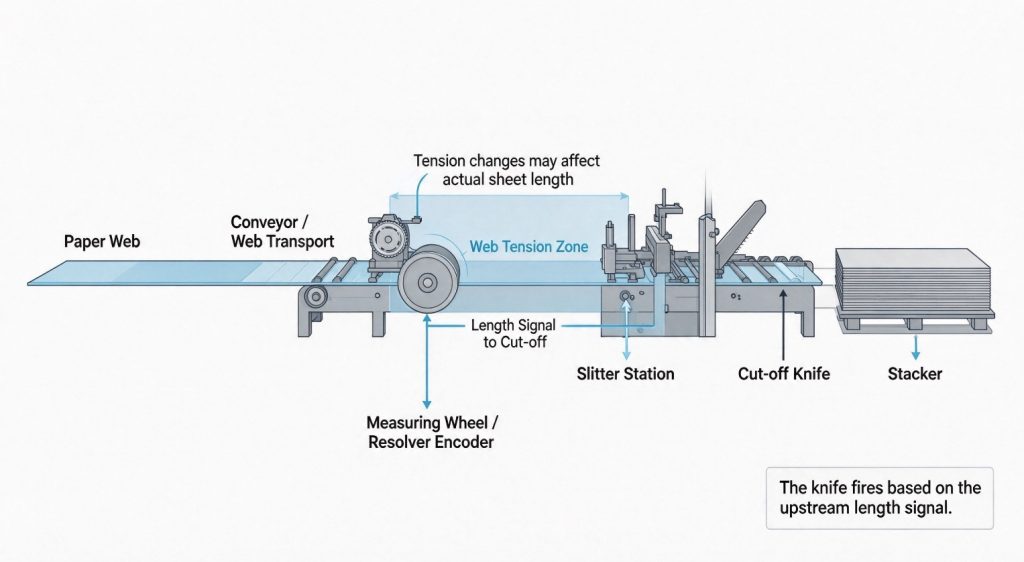
The cut-off doesn’t “know” the board’s length. It fires based on a length signal, usually from a measuring wheel or resolver upstream of the slitter. Dry-end control literature describes a length measuring device ahead of the slit line that feeds the sheet length signal to the knife, and notes that tension changes in the output webs during the cutting cycle can alter the sheet length.
That tells you the two places errors enter: the signal can be wrong, or the board can move differently than the signal says. Most causes below fall into one of those two buckets.
6 Common Causes of Corrugated Board Cutting Issues
1. Measurement errors: the encoder and measuring wheel
If the length signal is off, nothing downstream can fix it. A worn or dirty measuring wheel, a loose coupling, or electrical noise on the encoder line all cause errors, and the variation tends to look random rather than steady.
A real example: while testing a corrugated cutting machine, a fabricator found the finished sheet length was inconsistent because the encoder feeding the cutter occasionally missed counts, and a replacement encoder resolved it. Random, unpredictable variation is a good reason to look at the measurement chain before touching the knife.
2. Web tension and slippage
If the board isn’t moving at the speed the wheel thinks it is, the sheet length drifts. Worn belts, uneven pressure on the double backer, or a slipping drive roll stand all let the board creep.
Tension also changes during the cut itself. The same patent describes tension pulses in the web through each cutting cycle, which is why some systems actively control the nip forces so sheets come out a consistent length. The practical symptom is length error that gets worse as line speed goes up. The coordination between the wet end and dry end matters here too, which we cover in How Wet End and Dry End Coordination Keeps a Corrugator Line Running Smoothly.
3. Worn drive parts and timing belts
Mechanical slack shows up as length error before it shows up as noise. Gear backlash, loose couplings, and worn bearings all add small positional errors to every cut.
Timing belts deserve a specific look. A belt supplier reports that even 1% to 2% tooth wear on a converting drive can push cut length out of tolerance, and that the first sign is often a creeping increase in length variation rather than any noise or vibration. That figure comes from a parts vendor rather than an independent study, so treat it as a reason to inspect belts, not as a hard limit.
4. Knife condition and timing
A dull helical knife can drag the board instead of shearing it cleanly, which disturbs the sheet right at the moment length is set. The cut edge looks ragged, and the length wanders along with it. Check the knife gap, the blade condition, and the timing between the knife and the length signal.
On modern lines, a double-drive helical cut-off keeps the knife response tighter at high speed. If you’re comparing options, see the N.C. Helical Cut-Off (Double Drive) NC-C158H.
5. Order changes and control settings
If the errors cluster at order changes, look at the control side. Patent literature on order changes notes that cut length and angle can turn erratic at the change point until the sheet running conditions stabilize. Poorly matched acceleration and deceleration, outdated compensation parameters, or a splice that disturbs web tension can all produce a run of bad sheets every time the schedule changes. uspto
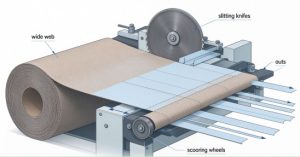
The slitter scorer upstream matters here as well, since slit position and sheet transfer affect what reaches the knife. Our N.C. Scorer Slitter range is built with that handoff in mind.
6. The board itself
Moisture, warp, and temperature all affect the board you’re measuring. A sheet cut right at the line can measure differently after it cools and settles, so make sure your checks are done consistently, at the same point and after the same wait. Otherwise you may chase an error that isn’t in the machine at all.
How Much Variation Is Too Much?
There isn’t one universal answer, because tolerance comes from your customer’s spec and what happens to the sheet afterward. Downstream tolerances also stack. One packaging industry article points out that overall blank length can vary by about ±1/8 inch once individual tolerances add up. A small cutting error combined with scoring or slotting variation can turn into a real problem for case erectors and packers. Confirm the target tolerance with your customers and engineers before you decide how tight the line needs to run. are needed.
A Diagnosis Order That Saves Time
Work from the simplest and cheapest checks toward the hardest:
- Pattern first. Is the error random, a steady drift, or tied to speed or order changes?
- Measurement chain. Inspect and clean the measuring wheel, then check the encoder coupling and cabling.
- Belts and pressure. Look at belt wear, double backer pressure, and drive roll stand grip.
- Knife and drives. Check blade condition, gap, timing, and any mechanical slack.
- Settings. Review compensation and acceleration parameters, especially if the problem follows order changes.
- Measuring method. Confirm sheets are measured the same way each time.
Random errors usually point to step 2. Drift at speed points to step 3. Errors only at order changes point to step 5.
When The Equipment Is The Limit
Sometimes you’ve done the checks, recalibrated again, and the variation keeps coming back. That’s a sign the drive or control system may have reached its limit. Aging drives, worn mechanical parts, and basic control logic can only hold corrugated board cutting accuracy so far. If you’re weighing an upgrade or want a second opinion on your current line, the engineering team at Hsieh Hsu can review your configuration. Send your line details through the contact page.
The Short Version
Inconsistent length usually traces back to one of five areas: the length signal, board movement, worn mechanical parts, knife condition, or control settings. Check them in that order, measure consistently, and you’ll find the cause faster than guessing. Good corrugated board cutting comes from the whole line working together, not from the knife alone.