The marks of a flute’s crush are among the most gruesome issues a corrugated plant could face. The board appears fine at first glance, but the flute tips get stretched, flattened, or scuffed under the liner. It’s rarely a single mistake — the root cause usually sits somewhere between the single facer’s guiding mechanism, roll condition, and paper moisture. We break down where crush marks come from, why they matter more than they look, and how to systematically prevent them.
What Are Flute Crush Marks? (Definition & Visual Signs)
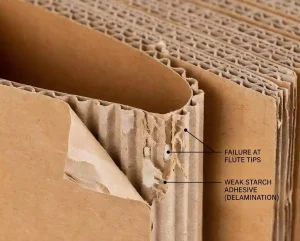
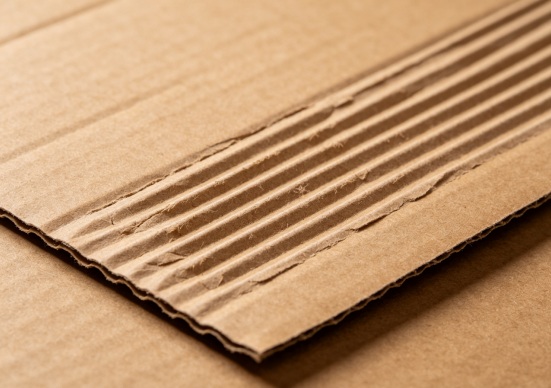
Flute crush marks are thin or striped areas on the peaks of corrugated medium. They are usually seen as thin parallel lines or small scratches when you peel back or bend the liner. They typically run in the machine direction, tracking wherever a guiding component made repeated contact with the flute tip during forming.
It’s worth distinguishing crush marks from other common defects before troubleshooting. Warping results from uneven moisture or tension across the web, not localized pressure. Blistering shows as raised, unglued pockets where the liner separated from the flute tip. Delamination is a full liner-to-medium bond failure. Crush marks are specifically a forming-stage defect — the flute geometry itself has been physically deformed before or during bonding.
Why Flute Crush Marks Matter for Box Quality & Cost
A crushed flute isn’t just cosmetic. Flute height and shape directly determine the board’s edge crush resistance, which is measured using standardized methods such as TAPPI T 811/T 838 and ISO 3037. This edge crush test (ECT) value feeds directly into the McKee formula, the industry-standard equation used to predict box compression strength from board properties. When flutes are compressed or deformed, the effective column strength of the corrugated structure drops, weakening stacking performance exactly where customers rely on it most — warehouse storage and transit.
Beyond the issue of strength, visible marks from crushing are among the most frequently cited reasons for rejections by customers and reprints. This is especially true for printed or retail-ready boxes where consistency of the surface is a requirement of the specification for buyers. Frequent crush defects can also result in hidden downtime. Operators are forced to stop the machine to examine, adjust, and requalify settings. Every board that is rejected is scrap that has already consumed energy, paper and machine time.
Root Causes of Flute Crush Marks
Most crush mark problems trace back to one of three categories: the mechanical guiding system, the process settings, or the paper itself.
Mechanical causes. In finger-type single facers, the guide fingers physically press the medium into the corrugating roll. A misaligned finger bar, worn or bent fingers, or a finger radius that no longer matches a recently reground roll are frequent sources of localized crush marks, since the fingers make direct contact with the flute tips throughout the run. Corrugating roll wear compounds the issue — as roll profiles degrade, contact pressure becomes uneven across the web width.
Process causes. Excessive pressure roll loading, incorrect preheater temperature, or running speed that isn’t matched to steam pressure and paper moisture can all deform flutes even on well-aligned equipment. When pressure settings are pushed higher to compensate for poor bonding elsewhere in the line, flute tips absorb the extra load.
Material causes. Uneven moisture content across the medium roll changes how the paper responds to forming pressure — drier zones are more brittle and prone to crushing, while overly wet zones can deform under normal pressure. Lower basis weight mediums are inherently more vulnerable to marking from direct mechanical contact than heavier stock.
How to Diagnose the Real Cause on Your Line
Start with a quick visual inspection: check whether crush marks appear in a consistent, repeating pattern across the web (pointing to a specific finger or roll section) or randomly (pointing to moisture or pressure variation). Marks that appear only on certain flute profiles or after a roll change often indicate a mismatch between finger radius and roll geometry.
If your line runs a finger-type single facer and marks correlate with a specific lateral position on the web, the guiding system itself should be the first suspect. To isolate mechanical from process variables, try running the same paper lot at a reduced pressure roll setting — if marks disappear, the pressure or preheater settings are likely the driver rather than the fingers or roll.
How to Prevent Flute Crush Marks
Routine finger bar and roll maintenance is the first line of defense: check finger alignment and radius matching every time a corrugating roll is reground, and replace worn fingers before they start leaving marks rather than after. Optimizing pressure and speed settings for the specific paper grade in use — rather than running one fixed setting across all stocks — reduces unnecessary flute stress. Controlling paper moisture before it reaches the corrugating section, through consistent preheater and steam management, keeps the medium in its ideal forming range.
For plants that repeatedly struggle with crush marks despite good maintenance discipline, the underlying guiding technology is often the real limiting factor. Fingerless single facers — whether vacuum-based or positive-pressure — eliminate the direct mechanical contact that causes most finger-related crush marks in the first place, since the medium is held against the roll by air pressure rather than physical fingers.
Hsieh Hsu’s Solution: Reducing Flute Crush at the Source
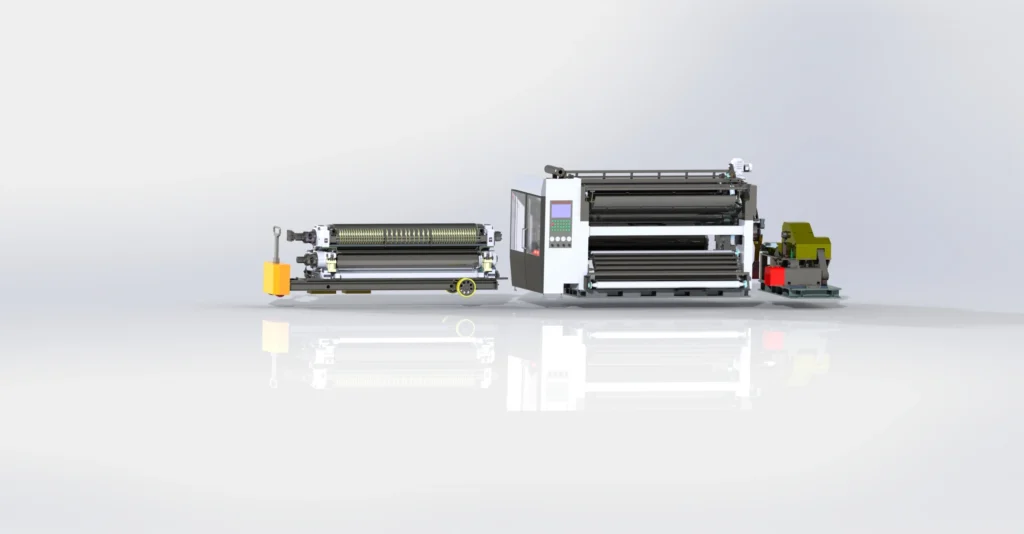
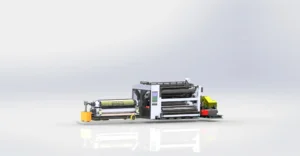
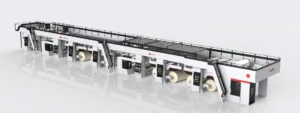
Hsieh Hsu’s Multi-Cassette Positive Pressure Single Facer was engineered around exactly this problem. By replacing mechanical fingers with a positive-pressure, fingerless forming method, it removes the direct-contact source of crush marks while avoiding the dust sensitivity that conventional vacuum systems can develop over time. Its multi-cassette roll configuration also allows faster flute changeovers, so plants don’t have to trade forming quality for production flexibility. For operations evaluating a new single facer or upgrading an aging line, Hsieh Hsu’s engineering team can assess your current paper stock, speed targets, and defect history to recommend the right configuration.
Flute crush marks rarely come from a single cause — they sit at the intersection of mechanical condition, process settings, and paper quality, which is exactly why isolated fixes often don’t stick. A systematic check of the guiding system, pressure and speed settings, and moisture control will resolve most cases, and for plants facing recurring issues, moving to a fingerless, positive-pressure single facer addresses the problem at its structural source rather than managing it run after run.