The mill roll stand is the first machine in a corrugator line and often governs the actual line run minutes. Each roll change is either a smooth flow or a production stall. The big design tradeoff is whether to keep putting shafts into paper cores, or switch to a shaftless system that grabs the core directly. Each approach has genuine merits. Let’s look at changeover, labor, safety and cost so you can choose what is right for your factory.
What Does a Mill Roll Stand Do in a Corrugator Line?
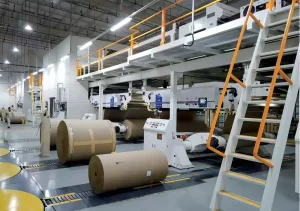
A mill roll stand sits at the wet end of the line. It holds the base paper rolls, elevates them to position and unwinds to feed the single facer, the first processing station on a corrugator. The stand is crucial for all downstream processes that need a steady paper supply, and influences roll change time, unwind tension, operator safety and paper waste.
That is why it deserves more attention than its position at the “back” of the line suggests. A slow or awkward roll change costs output every shift, even if every other machine runs perfectly.
How a Shafted Mill Roll Stand Works
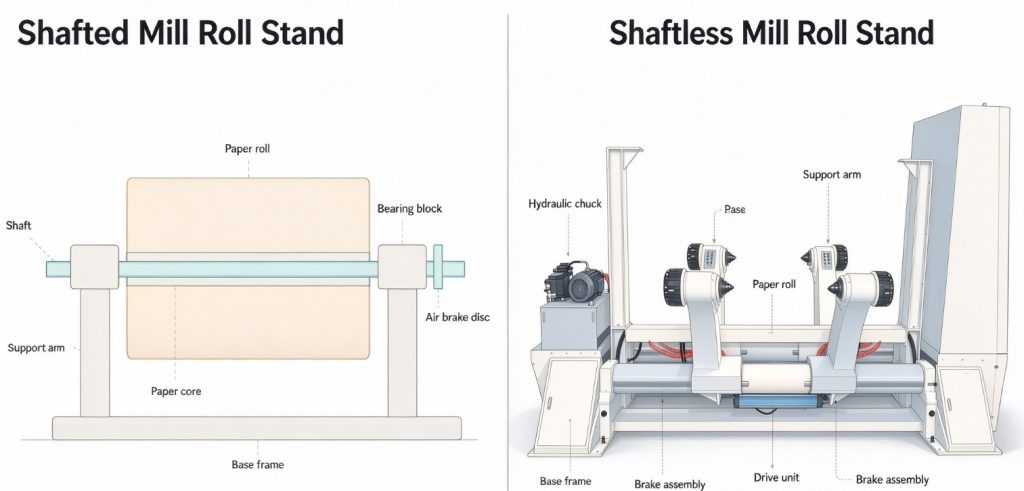
In a shafted design, a shaft is pushed through the core of each paper roll, and the stand’s arms support the shaft ends. When a roll runs out, operators remove the empty core and shaft, insert the shaft into a new roll, and lift it back into position.
This configuration is very effective and is widely used. It tolerates varying quality cores in general and can be operated reliably by plants with established shaft handling routines. The trade-off is labor. Shafts have to be inserted, removed, moved and stored. A plant will typically require enough shafts to keep rolls staged in advance.
How a Shaftless Mill Roll Stand Works
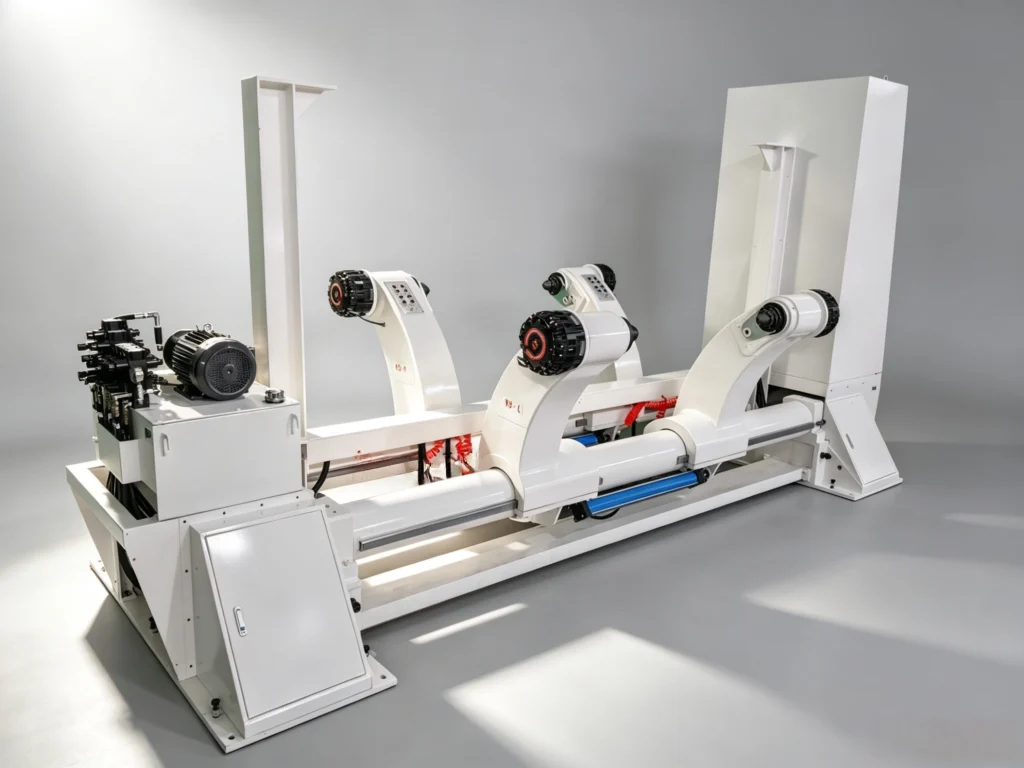
A shaftless stand skips the shaft. Chucks grip the core at each end so the roll can be clamped, lifted and positioned without anything passing through it. The core is fitted with one of two common types of chuck, toothed (jugged) chuck or expansion chuck.
Hydraulics usually drive the movement. As an example, the Hsieh Hsu MRS-V6 uses a fully hydraulic system for clamping, left-right positioning, and lifting, powered by a 10 HP hydraulic unit. The manufacturer says each stand has two pairs of arms, allowing the next roll to be set up as the current roll feeds the line. Unwind tension comes from an imported air brake, adjusted by hand, as roll diameter falls from 1,600 mm to 320 mm.
Shaftless vs. Shafted: Side-by-Side Comparison
The table below reflects general industry patterns. Your own results will depend on equipment, paper, and crew.
| Factor | Shafted stand | Shaftless stand |
| Roll change | Shaft insertion and removal required | No shaft to insert or remove |
| Manual handling | Shafts moved by hand or hoist | Hydraulic movement reduces handling |
| Shaft inventory | Multiple shafts to manage | None needed |
| Core requirements | Generally more forgiving | Core size and quality must suit the chuck |
| Maintenance focus | Shaft wear and straightness | Hydraulics and chucks |
| Upfront cost | Typically lower | Typically higher |
There is no column that wins all rows. It is contingent upon what rows are more important to your plant.
When a Shafted Roll Stand Still Makes Sense
Shafted stands still make a lot of sense in a lot of situations. If your plant only changes rolls a few times per shift, you may not save much time by switching to shaftless. If your cores are different sizes or condition a shaft is more forgiving than a chuck which requires a consistent core. And if you’ve got shafts working well or your capital is short, it may not be the best use of money to replace a working system.
When a Shaftless Roll Stand Is the Better Option
Shaftless designs are great when changeovers are frequent and every minute of downtime hurts. They’re also handy if you want to reduce physical handling. The UK Health and Safety Executive’s manual handling guidance prioritizes avoiding hazardous manual handling where reasonably practicable, for example mechanizing the task, then assessing and minimizing the risk of what remains. One way to adhere to that rule is to cut shafts out of the routine.
Shaftless stands can also be suitable for plants that want a cleaner floor with fewer shafts to store, or lines being upgraded where the wet end needs to match modern equipment.
Measure your current downtime and turn the decision from opinion to arithmetic
FAQ
What is a shaftless mill roll stand?
It is a roll stand, which grips the paper core with chucks instead of a shaft. So rolls can be clamped, lifted and positioned without inserting a shaft.
Is a shaftless stand always preferable to a shafted stand?
Nope. It is contingent upon the roll-change frequency, core quality, budget, and your plant’s handling practices.
What are the kinds of Chuck?
Common are toothed and jugged chucks and expansion chucks, selected according to the core.
Summary
Between shafted and shaftless designs, there is no universal winner. A shafted mill roll stand works well when changeovers are infrequent and cores vary, but when your biggest costs are frequent changeovers and manual handling, a shaftless one pays off. Begin by taking a measurement of your downtime and roll specs and compare options to those numbers. If you are thinking about a shaftless system, you can give your roll data to the team at Hsieh Hsu Machinery and receive a customized recommendation.